OK Rummy 1C$
My Safe First Look at OK Rummy 1C$
When I write about OK Rummy 1C$, I treat it as a responsible-gaming topic first, not as a promise of easy play or guaranteed results. My main focus is simple: I want to understand what the 1C$ entry point means, what risks may exist, and what I should check before making any decision. I do not see a small amount as a reason to ignore caution. Even a low entry value can create risky habits if I use it without limits.
For me, OK Rummy 1C$ should be reviewed through control, legality, transparency, and personal discipline. I do not treat it as income, a shortcut, or a way to recover losses. I look at it as a gaming-related feature that may involve financial risk and should only be considered by adults who are legally allowed to access such services in their location.
Why I Treat 1C$ Carefully
A small entry amount can feel harmless, but that is exactly why I stay alert. The risk is not only the amount itself. The real risk is repetition. If I keep returning again and again because each action feels small, the habit can become larger than I planned. That is why I set boundaries before I even look at account features.
I ask myself whether I understand the rules, whether the platform explains restrictions clearly, and whether I can stop without pressure. If I feel rushed, curious in an unhealthy way, or tempted to continue just because the entry point looks low, I step back. Responsible use starts before any click.
What I Check Before Using OK Rummy
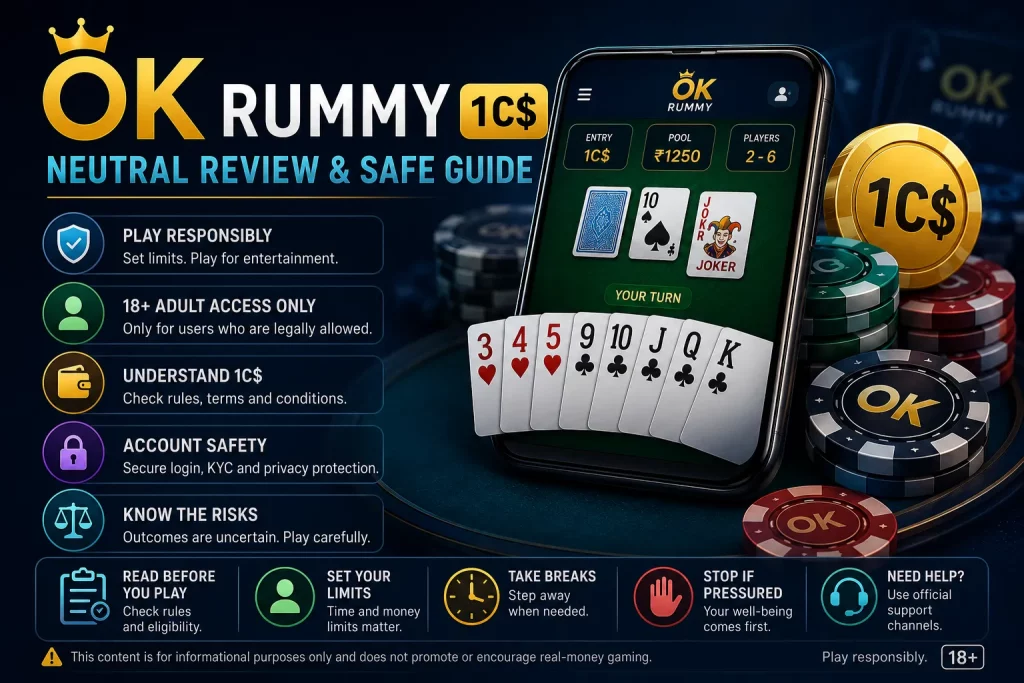
Before I interact with OK Rummy, I check the legal and safety basics. I want clear age information, visible responsible-gaming guidance, account security details, privacy wording, and transparent terms. If the platform does not explain these points clearly, I do not treat it as trustworthy.
I also check whether the site separates entertainment from financial expectations. Any page that makes gaming sound like income is not reliable to me. A responsible page should say clearly that outcomes are uncertain and that users should never use money needed for bills, family needs, education, savings, or emergencies.
Legal access
I first confirm whether rummy-related money features are allowed in my location and whether the platform explains restrictions clearly.
Age control
I expect clear adult-only access rules and responsible-gaming notices before any account or payment-related feature appears.
1C$ limit
I do not let a small entry value reduce my caution, because repeated small actions can still create unhealthy behavior.
Stop rule
If I feel pressure, frustration, or a desire to chase previous outcomes, I stop instead of continuing.
My Responsible Account Approach
If I review an account area, I focus on safety. The Login process should feel secure and private. The Sign up journey should not hide age restrictions, legal notes, or verification requirements. Any Bonus wording should be clear, limited, and never presented as guaranteed value. If there is an App, I would only consider official download routes and avoid unknown files or third-party links.
I also expect the platform structure to be clean. Sections like Games, Slots, FAQ, and Links should help users understand the site, not pressure them into fast action. Good internal linking should guide readers to rules, safety pages, terms, and support information.
My Personal Rule for OK Rummy 1C$
My personal rule is that I only continue when I can stop easily. If stopping feels difficult, I do not continue. I do not use OK Rummy 1C$ when I am stressed, tired, angry, bored, or worried about money. I also do not use it as a way to fix previous losses or create income.
For me, the safest OK Rummy experience is not about constant activity. It is about reading carefully, understanding the risk, respecting legal limits, and knowing that not playing is always a valid decision.
How I Continue My Neutral Review of OK Rummy 1C$
When I continue looking at OK Rummy 1C$, I keep the same careful approach. I do not treat the low 1C$ point as a reason to relax my judgment. A small entry value can make a platform feel lighter, but the responsible question stays the same: do I understand the risk, the rules, and my own limits before interacting with anything connected to money?
For me, the most important part is not the game itself. It is the structure around the experience. I look at whether OK Rummy explains account safety, legal availability, responsible-use tools, payment conditions, and user support in clear language. If these details are hard to find, I consider that a weakness.
Why the 1C$ Detail Needs Context
The 1C$ detail may look simple, but I do not judge it only by the number. I ask what it means in practice. Is it an entry value, a wallet unit, a promotional figure, or a platform-specific currency reference? If the page does not explain this clearly, I do not assume anything.
A responsible page should describe 1C$ without exaggeration. It should not suggest that a small amount removes risk. It should explain that repeated small actions can still affect behavior, time, and spending habits. That is why I prefer neutral wording over emotional claims.
I check what 1C$ means
I do not assume the value is harmless. I first look for a clear explanation of how it works inside the platform.
I review access rules
I check age limits, location restrictions, and whether the platform explains who should not use real-money features.
I set personal boundaries
I decide my time and spending limits before any activity, not during an emotional moment.
I stop if pressure appears
If I feel urgency, frustration, or the desire to continue only because of a previous result, I stop immediately.
How I Measure Responsible Use
I measure responsible use by control, not by activity. If I can read the rules calmly, understand the 1C$ meaning, set limits, and leave without pressure, the experience is more controlled. If I feel pulled back repeatedly, then the low value does not matter anymore.
The safest approach is to treat OK Rummy 1C$ as something that requires attention before action. I do not connect it with income, winning expectations, or financial recovery. I keep the language practical: check, read, limit, pause, stop.
My Neutral Conclusion on This Stage
At this stage, I would not describe OK Rummy 1C$ as something to chase or promote. I would describe it as a feature that needs careful reading and strict personal boundaries. The lower the entry point feels, the more important it becomes to notice repetition, emotion, and impulse.
My neutral view is that OK Rummy 1C$ should be approached only with legal awareness, adult-only access, account safety, and responsible limits. If those conditions are missing, unclear, or difficult to maintain, the safer decision is to step away.
How I Continue Reviewing OK Rummy 1C$ Neutrally
When I continue my neutral review of OK Rummy 1C$, I focus less on how the platform presents itself and more on how a user can understand the conditions around it. The 1C$ reference may look small and simple, but I do not treat it as automatically safe. I look at the full context: what the value means, how it is used, what rules apply, and whether the platform explains possible limits clearly.
For me, a neutral review should not push anyone toward action. It should help the reader slow down and understand what to check. If OK Rummy 1C$ is connected with any money-based feature, then responsible use, adult-only access, legal availability, and spending boundaries become essential. Without those points, the page would feel incomplete.
Why I Compare Platform Clarity and Personal Control
I separate my review into two parts. The first part is platform clarity. I check whether OK Rummy explains eligibility, account rules, verification, privacy, payment conditions, and restrictions in plain language. The second part is personal control. I ask whether I can read calmly, set limits, and stop without pressure.
A platform can have organized pages and still be unsuitable for a person at a particular moment. If I am tired, stressed, distracted, or thinking about previous outcomes, I do not consider that a good time to continue. Responsible behavior depends not only on the platform’s design, but also on the user’s condition.
What I expect to understand
- What 1C$ means inside OK Rummy and whether it is linked to entry, wallet value, or platform credit.
- Which age, location, verification, and responsible-use rules apply before any account activity.
- How limits, privacy controls, account security, and support options are presented to users.
- Whether the platform explains risk without making small values sound risk-free.
What makes me pause
- The 1C$ value is shown without a clear explanation of rules, conditions, or possible restrictions.
- The page uses urgency, emotional wording, or repeated prompts instead of calm information.
- Legal availability, account closure, or responsible-gaming tools are difficult to find.
- The experience makes repeated small actions feel automatic rather than deliberate.
How I Read the 1C$ Feature Without Overreacting
I do not overstate the 1C$ feature, and I do not dismiss it either. A neutral review should explain that low-value access points can reduce the feeling of risk, but they do not remove the need for careful behavior. The issue is not only how much one action costs. The issue is how often actions repeat and how the user reacts emotionally.
That is why I pay attention to friction. A responsible platform should give users enough friction to think: visible terms, clear confirmations, readable rules, and easy access to safety information. If everything is designed only to keep the user moving, I consider the experience less balanced.
Why Account Safety Still Matters
Even when discussing a small 1C$ value, account safety remains important. A user account may contain personal data, identity details, payment information, or activity history. Because of that, I look for secure access, official communication channels, and privacy explanations.
I would not use unofficial links, unknown app files, random support numbers, or copied messages from groups. If a platform needs verification, the process should happen through secure official pages only. If the request looks unusual, rushed, or unclear, I would stop and verify before doing anything else.
How I Keep the Tone Neutral
A neutral OK Rummy 1C$ page should not sound like advertising. It should not say that the feature is exciting, profitable, or easy. It should explain what a user should check and why those checks matter. The tone should be calm, practical, and realistic.
I also avoid turning personal caution into a guarantee. Even if someone sets limits, risk can still exist. Even if the entry value is small, repetition can still matter. Even if the game is familiar, emotional decisions can still appear. Neutral content should leave room for those realities.
My Practical View at This Stage
At this stage of my OK Rummy 1C$ review, I would summarize my position carefully. The 1C$ detail may be relevant to how the platform presents access, but it should never replace legal checks, age restrictions, responsible-use tools, account protection, or personal limits.
I would continue only if the platform gives clear information and if I remain fully in control. If either side is weak, the safer decision is to step away. For me, the neutral conclusion is that OK Rummy 1C$ should be approached as a risk-aware feature, not as a reason to act quickly.
My Final Neutral View of OK Rummy 1C$
At the final stage of my OK Rummy 1C$ review, I do not try to make the feature sound better or worse than it is. I look at it as a small-value platform element that needs clear explanation, careful reading, and responsible limits. The 1C$ point may seem minor, but I do not treat any money-related gaming feature as risk-free.
For me, the key question is not whether 1C$ looks accessible. The key question is whether I understand what it means, where it applies, what restrictions exist, and whether I can walk away without pressure. If the answer is unclear, I prefer not to continue.
What I Check Before Making a Decision
I review the platform through several neutral checkpoints. I look for legal availability, adult-only access, clear account terms, privacy protection, responsible-use tools, and support information. I also check whether the platform avoids exaggerated wording. A serious page should not make small-value access sound like a guaranteed advantage.
1C$ meaning
I check whether the platform clearly explains how 1C$ works and where this value applies.
Legal access
I look for location rules, age limits, and visible restrictions before considering any account activity.
User control
I check whether I can set boundaries, pause, stop, and avoid repeated automatic actions.
Account safety
I expect secure access, official support channels, privacy information, and clear verification rules.
Neutral wording
I avoid pages that describe small-value gaming as risk-free, easy income, or a shortcut to results.
Stop signal
If I feel pressure, urgency, or emotional involvement, I treat that as a reason to stop.
How I Understand Risk at the End of the Review
The main risk with OK Rummy 1C$ is not only the value itself. The larger issue is repetition, impulse, and unclear boundaries. A small amount can feel harmless, but if it encourages frequent activity, the experience can become less controlled.
That is why I measure the feature by behavior. If I can read the terms calmly, understand the conditions, set limits, and stop without hesitation, the situation is more controlled. If I feel pulled back repeatedly, then the 1C$ point no longer feels neutral.
My Neutral Final Conclusion
My neutral conclusion is that OK Rummy 1C$ should be described carefully, without promotional pressure. The feature may be part of the platform’s structure, but it still needs legal clarity, clear terms, adult-only access, account protection, and responsible-use information.
I would not present 1C$ as an advantage by itself. I would present it as a detail that users should understand before making any decision. If the platform explains it clearly and the user remains fully in control, the information can be reviewed calmly. If the explanation is unclear or the user feels pressure, the safer choice is to stop.
For me, the best final rule is simple: I only continue reviewing or using any feature when I can leave without hesitation. If stopping feels difficult, the feature is no longer neutral.






Comments