Book of Dead Overview for OK Rummy
Book of Dead is one of the most recognizable adventure-themed casino titles, built around a clear ancient Egypt concept, simple gameplay structure, and a reward system that is easy to understand. For OK Rummy, this type of page should present the game as a structured experience rather than just a basic slot description. The focus is on how the title works, what elements define its layout, and why its mechanics remain familiar to many online casino users.
The game is commonly associated with a classic reel format, symbol-based payouts, and a feature round built around expanding symbols. This makes Book of Dead easy to explain in a practical way: users need to understand the grid, the paylines, the symbol categories, and the main feature trigger. These elements create the foundation of the game and help separate it from more complex modern casino formats.
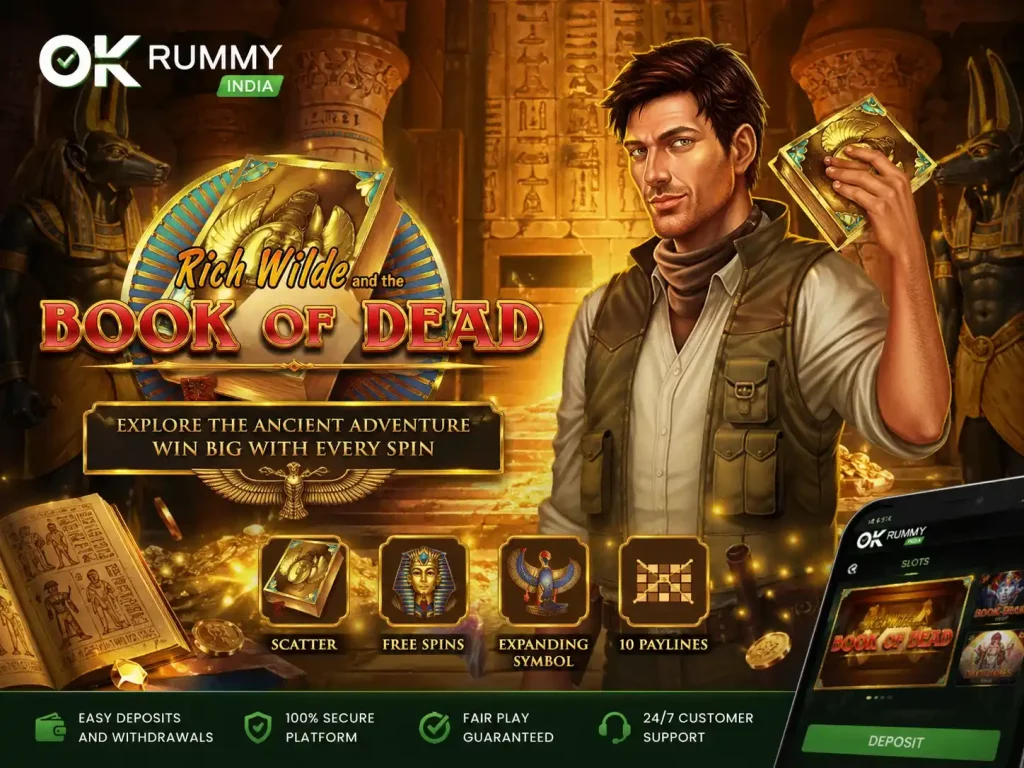
Unlike many newer titles that rely on layered mechanics, Book of Dead keeps its structure direct. The experience is built around reels, paylines, card-style symbols, explorer imagery, and the central book symbol. This simplicity is one reason the game is frequently searched by users who prefer straightforward casino formats. On an OK Rummy page, the explanation should remain clear, organized, and useful, without turning the content into unnecessary technical language.
The following table breaks down the main structural components of Book of Dead and explains how each part functions inside the game.
| Game Element | Function | Role in Gameplay | User Focus |
|---|---|---|---|
| Reel Grid | Displays the structured layout of symbols across all active reels. | Serves as the foundation for every spin and determines symbol positioning. | Observing symbol placement and alignment across the grid. |
| Paylines | Defines the paths where symbol combinations are evaluated. | Connects matching symbols across reels to form valid outcomes. | Tracking active lines and understanding how combinations are formed. |
| Book Symbol | Functions as both a scatter and a substituting symbol within the system. | Enables feature activation while also supporting standard combinations. | Monitoring its appearance as a key trigger for feature transitions. |
| Explorer Theme | Establishes the visual identity through an ancient adventure setting. | Supports recognition of the game and connects all visual elements. | Identifying the thematic style and overall game atmosphere. |
Book of Dead belongs to the category of Slots that rely on a familiar structure instead of complicated progression systems. This makes it easier to present on a casino page because the content can focus on practical understanding: what appears on screen, what symbols matter most, and how the main round connects with the feature round.
For OK Rummy, the page can explain Book of Dead as a game with a stable rhythm. The base round introduces the symbols and paylines, while the feature round adds a stronger point of interest through expanding symbols. This gives the game a clear two-layer structure: regular spins and special spins. The difference between these two phases is important because it helps users understand why the book symbol has a central role.
Another useful way to describe Book of Dead is by separating its components into visual, mechanical, and functional areas. The visual layer includes the Egyptian theme, character symbols, card values, and explorer elements. The mechanical layer includes reels, paylines, spin actions, and symbol combinations. The functional layer includes special symbols, feature triggers, and payout logic.
The chart shows that Book of Dead can be understood through a balanced mix of symbols, paylines, feature mechanics, and theme. Symbols and the feature round carry a large part of the game identity because they define both the standard spin experience and the special round structure. Paylines remain essential because they explain how combinations are formed, while the theme gives the title its recognizable style.
A good Book of Dead page for OK Rummy should avoid overcomplicating the introduction. The opening section needs to make the game understandable from the first screen. Users should quickly see that this is a reel-based casino title with a strong adventure identity, a central book symbol, and a feature round that adds extra depth to the regular spin format.
The next important point is accessibility. Before users interact with any casino title, they usually expect a simple path: access the platform, find the game section, open the title, and review the rules. That path may include account access, a secure login process, or navigation through the casino lobby. This should be described naturally without turning the page into a registration guide.
Book of Dead also works well as a topic because its structure is easy to compare against other casino games. It does not require a long explanation of complex bonus wheels, multiple meters, or multi-stage missions. Instead, the main focus stays on classic reels, special symbols, and the free spins-style feature. This direct format allows the content to remain readable while still being detailed enough for SEO.
| Content Area | What It Explains | Why It Matters |
|---|---|---|
| Game Identity | Covers the theme, visual direction, and overall structure of the game format. | Establishes a clear understanding of what the game represents within the platform. |
| Main Mechanics | Explains reel structure, paylines, and how symbol combinations are formed. | Provides a functional understanding of how gameplay operates on each spin. |
| Special Symbols | Focuses on the book symbol and its role within both base and feature gameplay. | Highlights the key mechanic that differentiates the game from standard reel systems. |
| Platform Context | Describes how the game integrates within the OK Rummy environment. | Connects gameplay structure with platform-level navigation and session flow. |
When describing Book of Dead for OK Rummy, it is useful to keep the first section focused on orientation. This means explaining the game’s structure before moving into deeper details such as symbol values, feature rounds, volatility, and mobile access. A strong introduction gives the page a clear base and makes later sections easier to build.
The game’s Egyptian setting is also important because it gives the title a strong visual identity. Ancient temples, explorer imagery, golden details, and mysterious book symbols all support the adventure concept. These details should be mentioned as part of the game’s identity, not as decorative descriptions. The goal is to connect the theme with the way the game is recognized by users.
In the context of OK Rummy, Book of Dead can be positioned as a classic-style casino title with a familiar structure and a simple learning curve. The content should explain that users can understand the main layout quickly, while still having enough detail to explore symbol behavior and feature mechanics in later sections.
The first part should also prepare space for later discussion of access options, gameplay flow, and platform usability. For example, a later section can explain how the game may be opened through a browser or app environment, while another section can describe how a bonus may connect with casino gameplay terms. These keywords should appear naturally and only once, without forcing them into repeated phrases.
Overall, Book of Dead is best presented as a structured casino title with clear rules, recognizable symbols, and a strong thematic identity. The opening section should establish what the game is, how it is organized, and why its format remains easy to explain on an OK Rummy SEO page.
Core Mechanics and Gameplay Flow of Book of Dead
After understanding the basic structure of Book of Dead, the next step is to break down how the gameplay actually works during a session. This section focuses on the internal flow of the game: what happens during spins, how symbols interact, and how the feature round is triggered and executed.
At its core, Book of Dead operates on a fixed reel system. Each spin generates a new combination of symbols across the grid, and outcomes are determined based on predefined paylines. The gameplay flow is repetitive by design, but within that repetition lies a structured pattern that defines the overall experience.
The game can be divided into two main operational layers: the base game and the feature round. The base game represents the standard spin cycle, where symbols appear and combinations are evaluated. The feature round introduces a modified version of this cycle, where expanding symbols and repeated spins create a different interaction model.
To better understand this, it is useful to map out how each gameplay phase behaves.
| Phase | Action | Symbol Behavior | Outcome Type |
|---|---|---|---|
| Base Spin | Standard reel rotation initiates a new spin cycle across all reels. | Regular symbols appear with substitution logic applied where applicable. | Line-based combinations are evaluated according to active paylines. |
| Scatter Trigger | Book symbols appear across the grid without requiring alignment on paylines. | Functions independently as a triggering element rather than a standard symbol. | Activates the transition into the feature round sequence. |
| Free Spins | A sequence of spins is executed automatically within the feature round. | A randomly selected symbol expands vertically when it appears on reels. | Increased combination density due to expanding symbol coverage. |
| Return to Base | The feature round concludes after all free spins are completed. | Expanding mechanics are removed and symbols return to default behavior. | The gameplay cycle resets and continues with standard spin flow. |
This flow demonstrates that Book of Dead is built around repetition with variation. The base game introduces the structure, while the feature round temporarily alters symbol behavior. This creates a loop where the user continuously transitions between standard spins and feature-based spins.
A key part of this system is the book symbol. It acts both as a scatter and as a substituting symbol, which means it has a dual role. This dual functionality is essential to understanding why it is central to the gameplay loop.
Another important aspect is the expanding symbol mechanic. During the feature round, a random symbol is selected to expand across reels when it appears. This changes the evaluation of paylines because a single symbol can fill an entire reel, creating multiple overlapping combinations.
To visualize how different mechanics contribute to the overall gameplay, the following chart presents the distribution of key actions within a typical session.
The chart shows that most of the gameplay time is spent in the base spin phase. Scatter events and feature spins occur less frequently but introduce variation into the cycle. Symbol expansion, while visually significant, happens only during specific conditions within the feature round.
From a structural perspective, this means that the game is not built on constant change, but rather on periodic variation. The majority of spins follow a predictable pattern, while specific events introduce temporary modifications.
Another useful way to break down the mechanics is by analyzing symbol types. Book of Dead uses a combination of high-value and low-value symbols, each with a defined role in the payout structure.
| Symbol Type | Category | Behavior | Special Notes |
|---|---|---|---|
| Explorer | High-value symbol group | Forms strong and less frequent combinations across active paylines. | Commonly selected as the expanding symbol during feature rounds. |
| Character Icons | Medium-value symbol group | Appears regularly and builds standard line combinations. | Provides balanced distribution between frequency and value. |
| Card Symbols | Low-value symbol group | Appears frequently and fills reel positions across most spins. | Supports consistent combination formation with lower individual impact. |
| Book Symbol | Special symbol | Functions as both scatter and substituting symbol within the game. | Triggers the feature round and connects base gameplay with bonus mechanics. |
This classification helps organize the symbol system into logical groups. Each category has a role, and together they form the complete payout structure.
Another important aspect of Book of Dead gameplay is pacing. The game operates at a consistent speed, with each spin following the same sequence: reel animation, symbol landing, evaluation, and transition to the next spin. This consistency makes the game predictable in structure, even though outcomes vary.
The feature round introduces a temporary shift in pacing. Because multiple spins occur in sequence, the user experiences a different rhythm compared to single-spin cycles. However, once the feature ends, the game returns to its standard flow without additional layers or transitions.
From a content perspective, this allows the page to explain gameplay without unnecessary complexity. The mechanics can be presented in a step-by-step format, making it easier to follow.
The timeline illustrates that each spin follows a structured sequence rather than random visual behavior. This sequence remains consistent across both base and feature gameplay, ensuring that the user always interacts with a familiar system.
For OK Rummy, this section helps build a clear understanding of how Book of Dead works internally. It moves beyond the general overview and focuses on mechanics, symbol behavior, and gameplay flow. This prepares the page for deeper topics such as feature variations, access options, and platform integration in the next sections.
Feature Mechanics and Symbol Expansion System
The most distinctive part of Book of Dead is its feature round, which introduces a variation of the base gameplay by modifying how symbols behave across the reels. While the base game remains consistent and structured, the feature round adds a separate layer where symbol expansion becomes the central mechanic.
The feature is activated when a specific number of book symbols appear on the reels. Unlike regular symbols, these do not rely on paylines, which allows them to trigger the feature independently of standard combinations. Once activated, the game transitions into a sequence of free spins, where a random symbol is selected as a special expanding symbol.
This expanding symbol defines the behavior of the entire feature round. When it appears on a reel, it expands to cover the full vertical space, effectively increasing the number of matching positions. This changes how combinations are calculated, since a single symbol can now occupy multiple slots on the reel.
To better understand how the feature behaves across its different stages, the following table breaks down the full process.
| Stage | Trigger Condition | Symbol Behavior | System Effect |
|---|---|---|---|
| Activation | Multiple book symbols appear across the reels independently of paylines. | No expansion occurs at this stage, symbols only act as a trigger condition. | The system transitions from base gameplay into the feature sequence. |
| Selection | A random symbol is selected at the start of the feature round. | The chosen symbol is assigned expanding properties for the duration of the feature. | Defines how combinations will be formed during all upcoming spins. |
| Expansion | The selected symbol lands on one or more reels during free spins. | Symbols expand vertically to fill entire reel positions when triggered. | Increases the number of overlapping line combinations within a single spin. |
| Completion | The predefined number of free spins is completed. | Expanding behavior is disabled and symbols return to their standard state. | The game exits feature mode and resumes the base spin cycle. |
This structured approach shows that the feature round is not random in its behavior, but follows a defined sequence. Each stage leads into the next, forming a controlled system where symbol expansion is the central mechanic.
Another important aspect is how different symbols perform when selected as expanding symbols. Not all symbols produce the same type of outcome when expanded. High-value symbols can create stronger combinations, while lower-value symbols generate more frequent but smaller patterns.
| Symbol Group | Expansion Behavior | Combination Density | Outcome Structure |
|---|---|---|---|
| High-value | Expands to cover entire reel height, maximizing symbol visibility when triggered. | Lower frequency of appearance within the feature sequence. | Produces concentrated line formations with stronger payout patterns. |
| Medium-value | Expands consistently across reels, maintaining a balanced presence. | Moderate frequency within the feature round cycle. | Creates a mix of overlapping and standard line combinations. |
| Low-value | Expands frequently, often appearing across multiple reels in sequence. | High density due to frequent symbol occurrence. | Generates repeated smaller combinations with consistent distribution. |
This breakdown highlights that the feature round behaves differently depending on which symbol is selected. Even though the mechanic itself remains the same, the resulting combinations vary significantly based on symbol type.
To visualize how symbol expansion contributes to the overall feature round, the following chart shows the relative impact of each symbol group.
The chart demonstrates that medium-value symbols often provide the most balanced contribution during the feature round. High-value symbols create stronger but less frequent outcomes, while low-value symbols generate more frequent but smaller combinations.
Another key factor in the feature system is its independence from external systems. The feature round does not rely on additional meters, progression bars, or layered bonus systems. It activates, runs its cycle, and ends without affecting future spins. This makes the mechanic self-contained and predictable in structure.
This type of system is particularly useful for content clarity. It allows the page to describe the feature without introducing external dependencies or extended explanations. Everything related to symbol expansion happens within a single, isolated sequence.
In the context of OK Rummy, the feature round can be presented as a clearly defined system that temporarily modifies the standard gameplay rules. It introduces expanding symbols, repeated spins, and a different combination structure, but does not change the overall game foundation.
This section builds on the previous one by focusing specifically on the feature mechanics. It explains how the system works internally and how symbol expansion affects outcomes. The next section will connect this system with platform access, usage environments, and broader interaction context.
Platform Access, Integration and Session Structure
After breaking down the mechanics and feature system, the final step is to connect Book of Dead with the broader OK Rummy platform environment. This section focuses on how the game fits into the platform structure, how users typically access it, and how sessions are organized across different devices.
Book of Dead is not an isolated system — it exists inside a larger platform that manages navigation, game selection, session handling, and account access. Because of this, it is important to explain how the game integrates into the OK Rummy ecosystem in a structured way.
The process usually begins with platform entry. A user accesses the platform through a browser or dedicated app, navigates to the game section, and selects the title. From there, the system loads the game interface and connects it to the user session.
This flow can be broken down into several key steps.
| Step | Platform Action | System Response | Result |
|---|---|---|---|
| Access Platform | Open OK Rummy through a browser or mobile device interface. | The platform loads the main environment, navigation system, and available sections. | User arrives at the primary dashboard ready for interaction. |
| Account Access | Enter account credentials or confirm an existing active session. | The system validates user data and connects to the active session layer. | Secure access is granted and platform features become available. |
| Game Selection | Navigate through categories or search to locate the game. | Game lists, filters, and sorting options are dynamically loaded. | Book of Dead is selected and prepared for launch. |
| Game Launch | Start the game session from the platform interface. | The game engine initializes reels, symbols, and interaction controls. | Gameplay begins with a fully loaded and active session. |
This table shows that Book of Dead is part of a continuous platform flow rather than a standalone product. Each step is connected, forming a complete access path from entry to gameplay.
Another important aspect is session structure. A session includes everything that happens from the moment the game is launched until it is closed. This includes spins, feature rounds, symbol evaluation, and transitions between game states.
| Session Layer | Core Description | Duration | System Flow |
|---|---|---|---|
| Entry Phase | Initial loading stage where the game environment, reel structure, and symbol set are prepared before interaction begins. | Short | System initializes assets, syncs session data, and prepares the first spin cycle. |
| Active Gameplay | Continuous interaction phase including standard spins, symbol evaluation, and feature round execution. | Variable | Loop-based system where spins repeat, features trigger, and gameplay cycles without interruption. |
| Exit Phase | Final stage where the session is closed and gameplay activity is stopped. | Short | System finalizes the session, stores state data, and safely exits the game environment. |
This layered structure shows that gameplay is not just a sequence of spins, but part of a broader session cycle. Each phase has a defined role, ensuring that the system behaves consistently from start to finish.
To better visualize how sessions evolve over time, the following chart represents a simplified session timeline.
The timeline illustrates how activity levels change during a session. The base spins create a steady rhythm, the feature trigger introduces variation, and the free spins phase represents a more concentrated sequence before returning to standard gameplay.
Another important factor is cross-device access. Book of Dead is typically available on both desktop and mobile environments, which means the game must adapt to different screen sizes and interaction models. On OK Rummy, this includes browser-based play as well as access through a dedicated app interface.
The system ensures that the same core mechanics are preserved across devices. The reels, symbols, and feature logic remain unchanged, while the interface adapts to the screen. This consistency allows the game to function as a unified product regardless of the device being used.
It is also important to understand how external elements interact with the game. For example, a bonus system may be connected to the broader platform rather than the game itself. This means that while Book of Dead operates independently in terms of mechanics, it can still be influenced by platform-level configurations.
From a structural perspective, this creates a layered model:
- The game layer handles reels, symbols, and feature logic
- The platform layer manages sessions, access, and navigation
- The system layer connects external features such as account data
This separation ensures that each part of the system operates independently while still contributing to a unified experience.
Book of Dead on OK Rummy brings together a structured reel system, clearly defined feature mechanics, and a consistent session flow within a unified platform environment. The game operates through a combination of base spins and feature rounds, supported by symbol behavior that remains predictable in structure while varying in outcome.
Each layer of the system — from core reels to expanding symbols and session handling — functions independently while still forming a connected gameplay cycle. This allows the title to remain easy to understand while maintaining a complete and organized structure across different access points and devices.
As a result, Book of Dead fits naturally within the OK Rummy platform, combining accessibility, clear mechanics, and a stable gameplay flow into a single, cohesive system.






Comments